I mentioned it only briefly, in passing really, last week.
Time to talk about it in earnest this week.
As you will hear in this PODCAST, THIS is our hope.
A bright and beautiful hope indeed!
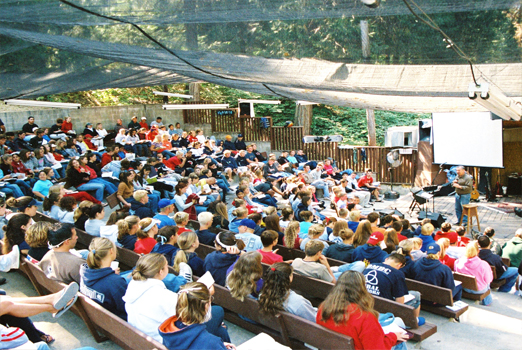
BTW, the cheering you will hear in the background are the precious high school students whom I met at Hartland Christian Camp in July. A better group of students you will not find. Anywhere.
May it be a blessing, to you as it was to them. Enjoy.
Please remember that depending upon your web browser and connection speed, it may take up to 60 seconds for this podcast to begin to play.
It is the single saddest day on the Jewish calendar.
As you are about to hear in this PODCAST, that statement, purposely given with the present tense “is,” is true today.
It was equally true for Peter’s original Jewish readers.
One day each year, indelibly imprinted on the collective psyches of our Jewish friends then and now.
“It is today as it was then.”
A day which reads in English, “the ninth day of the month of Av” (usually around our month of August).
In Hebrew it is called, Tisha B’Av.
If we don’t understand what this day is all about, we will not understand what the closing verses of 1 Peter 1 are all about. For Peter’s original readers. And for us!
Please remember that depending upon your web browser and connection speed, it may take up to 60 seconds for this podcast to begin to play.
As you are about to hear in this PODCAST, all you need to know about the precious people to whom Peter wrote is summarized in three telling terms. One phrase, really.
One phrase that so accurately described them.
One phrase that so accurately describes each of us.
ἐκ-λεκ-τοῖς παρ-επι-δή-μοις διασ-πορᾶς—literally, “elect foreigners in the diaspora.”
Now why in the world would Peter begin his first letter with this carefully crafted first phrase?
“Peter, an apostle of Jesus Christ, to the elect foreigners in the diaspora.”
Because the one question looming in minds of Peter’s distressed audience was this:
Has God abandoned us?
Not to get too personal with you, and at the risk of invading your private space, I cannot help but to wonder if you have ever asked of yourself that exact same question:
Has God abandoned me?
And Peter wanted them—and us—and you!—to know that as he penned this epistle, that same question was looming large in his own mind and his own soul.
Peter knew his audience.
Peter knew them.
Peter knows us.
Peter knows you!
Peter feels our pain.
Peter asks our questions.
Peter understands our doubts.
Peter feels our fears.
Peter can relate.
Peter “gets” it.
Peter “gets” us.
And I, for one, am profoundly grateful that he does.
And in “getting” us, he will assure us in this podcast that NO!!! God has NOT abandoned you. He has NOT turned His back on you. He will NEVER stop loving you. He will NEVER leave you. He will not now or EVER forsake you.
In a word, we are SECURE in His omnipotent hand.
Aren’t you glad?
Please remember that depending upon your web browser and connection speed, it may take up to 60 seconds for this podcast to begin to play.
Let me take you back to Tuesday of Jesus’ final week.
On that Tuesday, as you will hear in this PODCAST, Jesus made a most-remarkable promise to His disciples, and by extension, to us.
Allow me to remind you of what happened in Luke 21:
“Some of his disciples began talking about the majestic stonework of the Temple and the memorial decorations on the walls. But Jesus said, ‘The time is coming when all these things will be completely demolished. Not one stone will be left on top of another!’”
Now listen to His promise:
“But before all this occurs, there will be a time of great persecution. You will be dragged into synagogues and prisons, and you will stand trial before kings and governors because you are my followers. But this will be your opportunity to tell them about me. So don’t worry in advance about how to answer the charges against you, for I will give you the right words and such wisdom that none of your opponents will be able to reply or refute you!”
At the time, the disciples had no idea what Jesus meant by all of that. Now, here, in Acts 4, just 8-ten or so weeks later, they suddenly knew exactly what Jesus meant by all of that.
For first time in the now-nearly two thousand year history of Church, an earsplitting thunderclap of persecution now sounded throughout the Holy City, Jerusalem. So true to Jesus’ prediction made in Luke 21, Peter and John were unceremoniously dragged into prison, and held in there there overnight.
The next morning they were hauled before the highest levels of their religious hierarchy to stand trial.
Please remember that depending upon your web browser and connection speed, it may take up to 60 seconds for this podcast to begin to play.
As you will hear in this PODCAST, this fisherman-turned-preacher’s initial foray into the world of sermonizing is memorable in extreme.
And whether you realize it or not, Peter’s first sermon out of the gate is all about… Grasshoppers. As in locusts. Lots and lots of locusts.
A plague of locusts. A past-plague of locusts. A coming plague of locusts. And a future (even future for us) plague of locusts. See it there in Acts 2:14-16?
Listen as I read it to you, and see if you can hear ominous chomps of locusts:
Then Peter stepped forward with the eleven other apostles and shouted to the crowd, “Listen carefully, all of you, fellow Jews and residents of Jerusalem! Make no mistake about this. These people are not drunk, as some of you are assuming. Nine o’clock in the morning is much too early for that. No, what you see was predicted long ago by the prophet Joel.”
See any locusts in that? No? Well, then, keep listening. Because as you are about to hear, it is vital that we do.
His name is Joel. He is one of so-called 12 “Minor Prophets.” But make no mistake about this: Joel may have been a “Minor Prophet.” But there was absolutely nothing minor about his message.
Let me ever-so-briefly remind you of structure of the Old Testament…
Please remember that depending upon your web browser and connection speed, it may take up to 60 seconds for this podcast to begin to play.
As you are about to hear in this PODCAST, the Holy Spirit came to this earth in Jesus’ absence in part to bring a supernatural unity to committed Christ-followers throughout the world.
For example, we read in Ephesians 4:3, “Make every effort to keep the unity of the Spirit through the bond of peace.”
That phrase “the unity of the Spirit” notwithstanding, Christians throughout the world have arguably divided more over the gifts of Holy Spirit than any other single issue. Divisions that, quite frankly, have turned spiritually toxic.
There are those who will tell you and me with some measure of intensity that if you do not speak in tongues, you are at the least not filled with the Spirit; and at the worst, not a Christian at all.
There are those who will tell you and me with some measure of intensity that if you do speak in tongues, you are believing a false Gospel and consequently going to Hell.
So as we enter this discussion, I will give to you my promise, and make to you my plea.
Please remember that depending upon your web browser and connection speed, it may take up to 60 seconds for this podcast to begin to play.
Gifts of Gratitude: If interested in expressing your gratitude in this biblical, tangible way--by giving a gift directly to me, OR giving a gift to a friend or loved-one-in-need in my name--please click on the Gifts of Gratitude tab at the top of this page. Thank you!!!





 Dewey Bertolini